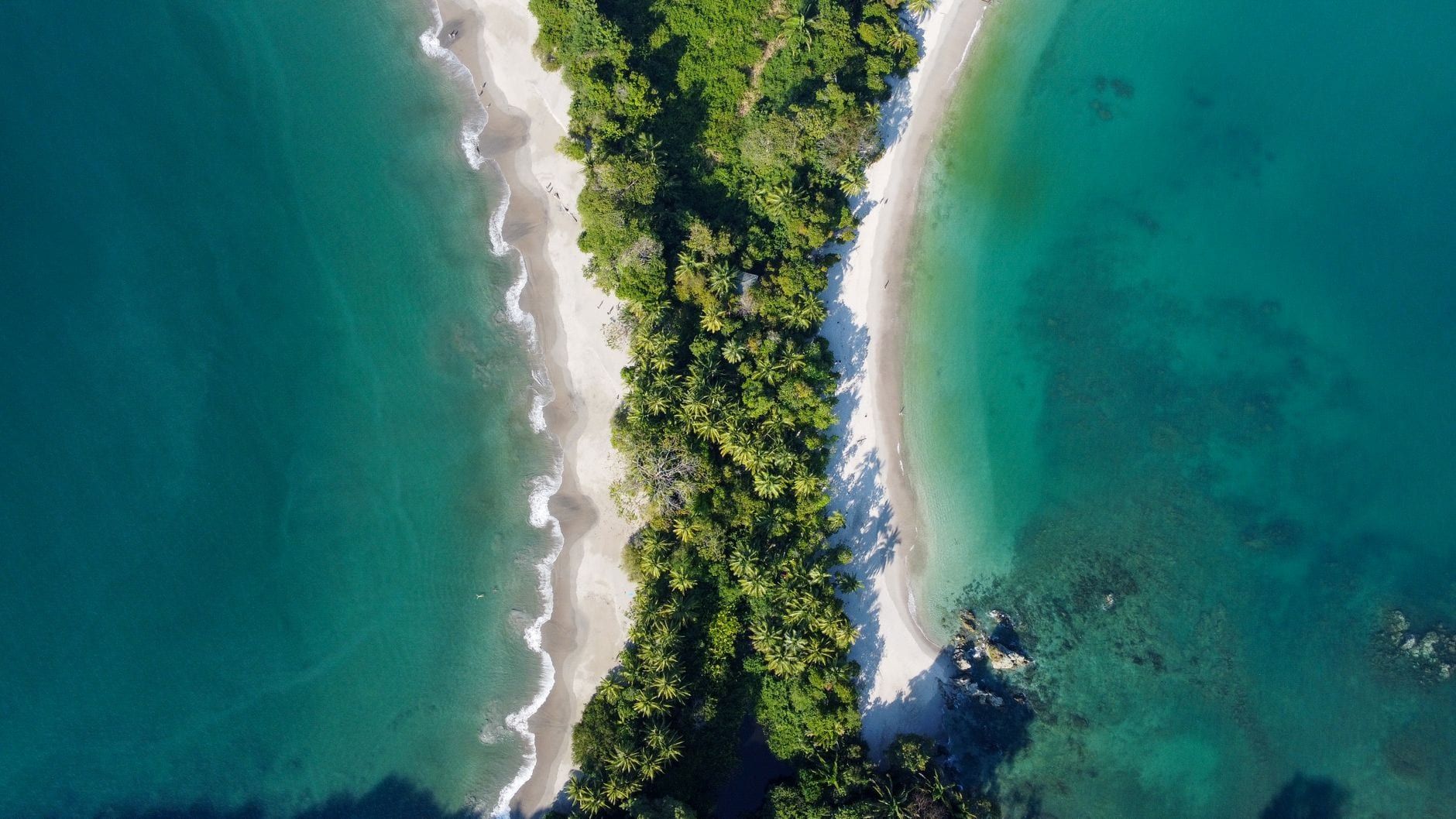
Yes — sloths live in Manuel Antonio National Park, and this stretch of Pacific coast is one of the most reliable places in Costa Rica to see them. Both of the country's sloth species are here: the brown-throated three-toed sloth, awake and visible by day, and Hoffmann's two-toed sloth, which sleeps through your visit as a ball of fur high in the canopy. The park itself is tiny — 1,983 hectares of rainforest squeezed between Quepos and the sea — yet it holds 109 recorded mammal species, and sloths rank among the most dependable.
Dependable doesn't mean automatic, though. Most first-time visitors walk straight past them, because a sloth at 40 feet looks like a knot of bark. This guide covers what the ranking blogs skip: which species you'll actually meet, the exact spots and hours, real costs, the online-only ticketing system, and how to find one yourself with nothing but binoculars and patience. (Cahuita, on the Caribbean side, has even higher sloth density — but Manuel Antonio is the Pacific's most accessible option, and it throws in four white-sand beaches.)
The Two Sloths of Manuel Antonio (and Which One You'll Actually See)
Costa Rica has two sloth species and both live here. Telling them apart is simple: one is awake while the park is open, and the other isn't.
Hoffmann's two-toed sloth: the night shift
Larger, shaggier, and strictly nocturnal, the Hoffmann's two-toed sloth eats fruit and leaves on a night schedule and sleeps around 15 hours a day. During park hours it's a grey-brown fuzzy ball wedged in a branch fork, 30–50 feet up — findable, but rarely identifiable without a scope. If watching one actually move is on your list, a guided night walk is the only realistic route.
Brown-throated three-toed sloth: the one you'll meet
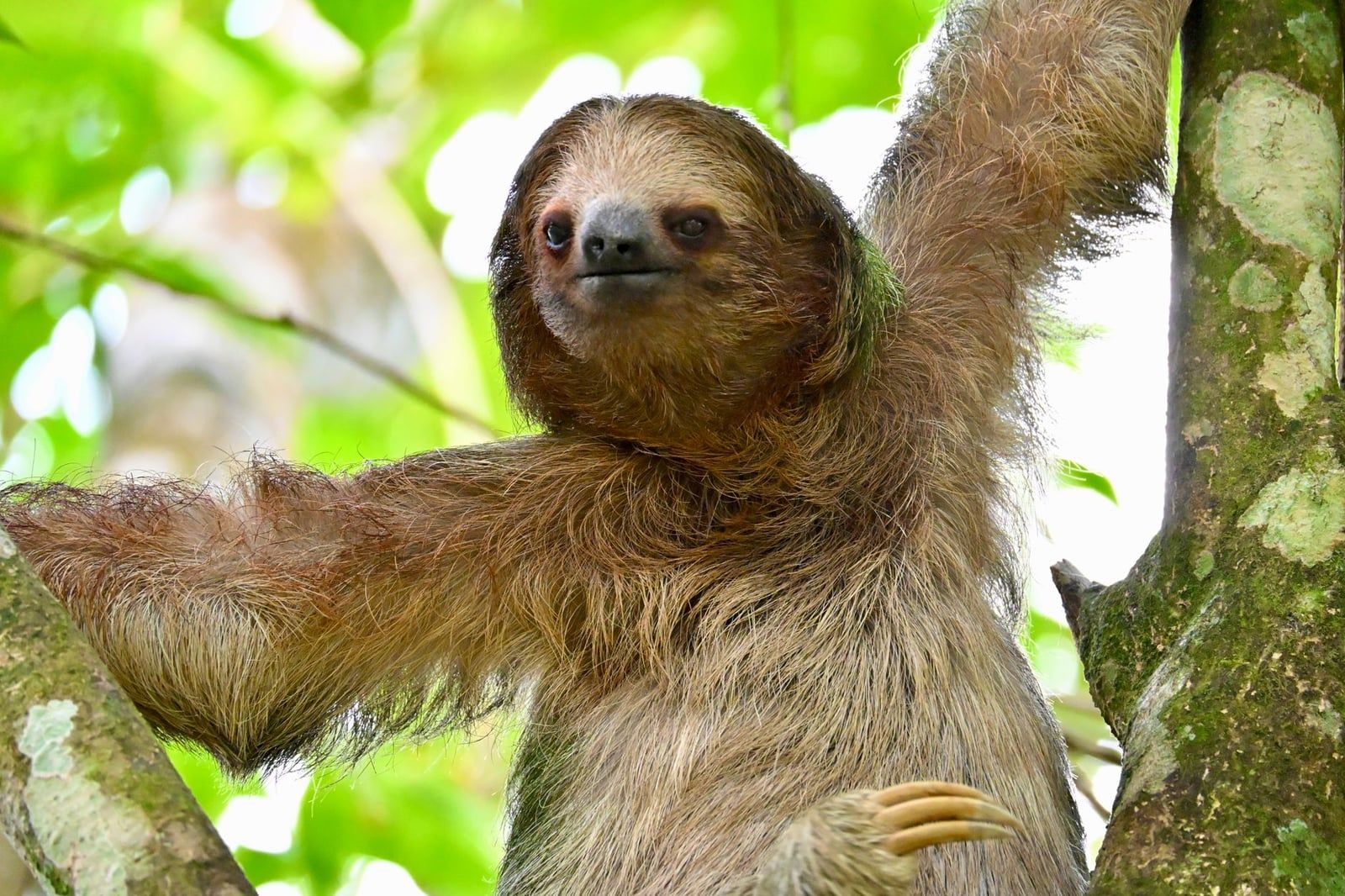
The brown-throated three-toed sloth is the poster animal — blondish coat, dark eye stripe, the famous permanent smile. It's active in daylight, feeding on leaves and shifting through the canopy so slowly it can spend hours in a single tree. That's good news for you: a sloth someone found at 8 a.m. is often still hanging there at 10.
Roughly 70% of sloth sightings on local tours are three-toed, simply because tours run when this species is awake. A few facts calibrate expectations: sloths sleep up to 15 hours a day, and they descend to the ground only about once a week, to defecate — the rest of their lives happen in the canopy. If you ever see one on the forest floor, keep clear and count yourself lucky.
Where to Look: Sloth Hotspots Inside and Outside the Park
Inside the park, one trail stands above the rest — and the best news is that some of the area's best sloth trees cost nothing at all.
Sendero El Perezoso: start on the Sloth Trail
The main access trail from the park entrance is literally named for the animal. Sendero El Perezoso runs flat and paved for about 1.1 km — 20 to 30 minutes at wildlife pace — through the cecropia stands where both sloth species are seen most often. Walk it slowly and scan upward; most visitors rush it in fifteen minutes and see nothing. It's also the park's wheelchair- and stroller-friendly route, so nobody in your group sits this one out.
Learn the cecropia tree
Half of sloth spotting is botany. The cecropia, or guarumo, is the sloth's favorite restaurant — and its open, umbrella-shaped canopy and pale trunk make a feeding sloth far easier to pick out than dense foliage ever would. Learn to recognize that silhouette once and every trail in the park becomes a targeted scan instead of a stare into green. Guides head straight for these trees; do the same.
The habit pays off outside the park too. Cecropias grow all along the road between Quepos and the entrance, and a roadside pause under one is free.
The forest edge behind the beaches
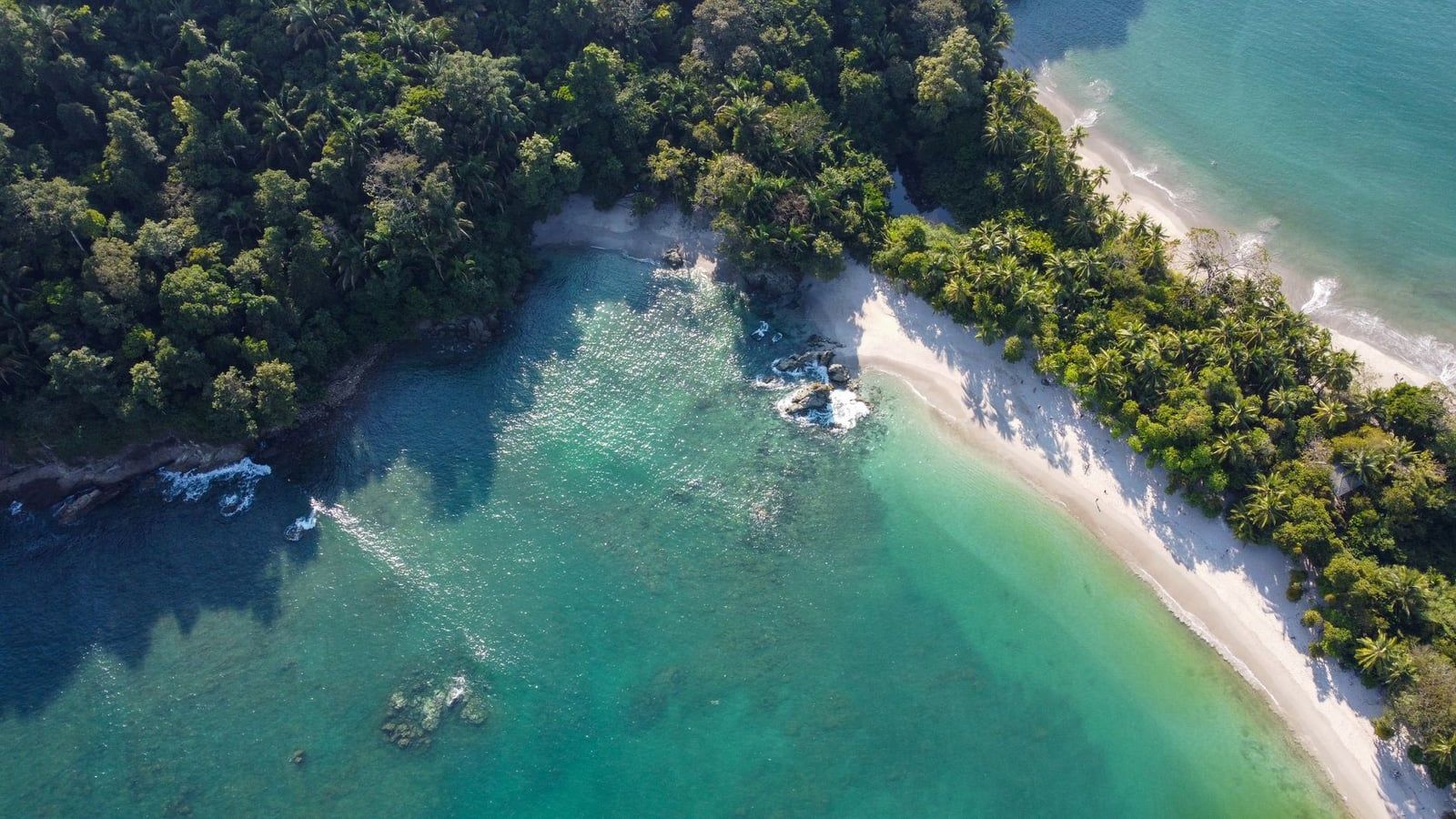
Where rainforest meets sand, behind Playa Manuel Antonio and Playa Espadilla Sur, the trees thin out and the light gets in. Sloths and monkeys both work this edge, and the walk from the end of the Sloth Trail toward the water passes directly beneath it. Pause between the beach and the treeline rather than heading straight for the surf.
Outside the park: sightings without a ticket
The whole Manuel Antonio area functions as a biological corridor, and wild sloths cross it constantly. Mature trees along the Quepos–Manuel Antonio road carry residents visible from below, and many hotels, vacation rentals, and restaurant grounds host a sloth or two — morning-coffee sightings are genuinely common. Ask at reception where theirs hangs out; the staff usually know the exact tree.
Best Time of Day and Season for Sloths
The clock matters far more than the calendar here — go early, and you can visit any month of the year.
The 6 to 9 a.m. window
Early morning is the whole game. Sloths feed and shift position in the cool hours, and low-angle light makes the canopy easier to read. Take the 7:00 a.m. entry slot and you buy yourself the two most productive hours of the day — by around 10 a.m., activity drops and midday heat pushes sloths deep into shade to rest. Late afternoon is the second-best window, but with the park closing at 3 p.m., there isn't much afternoon to work with. Plan around the morning.
Does the season matter?
For sloths, no — they're present every month of the year, so there's no sloth season to chase. Season changes your comfort, not your odds. Dry season (December to April) means sun, swim weather, and the year's heaviest crowds, with entry slots selling out ahead. Green season (May to November) brings clear mornings, afternoon rain, thinner trails, and lusher forest — and overcast green-season mornings are a hidden advantage, since diffused light kills the glare and sloths stay active when it's not hot. September and October are the wettest months; go early and expect mud.
Guided Tour vs. Going Alone: Odds, Costs and Options
Here are the honest numbers. A certified guide with a spotting scope routinely finds 3 to 5 sloths per group on a three-hour morning walk. Visitors going alone mostly see zero or one. The gap isn't luck — it's a scope resolving a fuzzy lump at 40 feet, plus a guide who already knows which tree today's sloth is in.
The cost ladder: park entrance is $18.08 for foreign adults 12 and up and $5.65 for children 2–12, under-2s free, tax included. ICT-certified guides work the park entrance from 7 a.m. to 2 p.m. for roughly $40–70 per person. Packaged tours run from about $26 for a shared group walk up to roughly $95 for a private outing — photographers should price a private tour, since the guide sets the pace around your lens. If you're going alone, binoculars rent for $5–10 at the entrance and are worth every colón.
| Option | Typical cost per adult | Duration | Best for |
|---|---|---|---|
| Self-guided visit | $18.08 entry only | Your pace | Budget and independent travelers |
| Certified guide at the gate | $40–70 plus entry | About 3 hours | First-timers who want the scope |
| Shared guided tour | From about $26 (entry often extra) | 2.5–3 hours | Best value, logistics handled |
| Private tour | Up to about $95 | Flexible | Photographers and families |
Where to book: certified guides cluster at the entrance (the Association of Certified Tour Guides of Quepos staffs it), and every established operator in town runs the same morning circuit — compare options and confirm a spotting scope is included before you pay. Our full tour rundown covers the operators worth shortlisting.
Night walks: the two-toed payoff
Since Hoffmann's two-toed sloths are nocturnal, the only realistic way to watch one move is a guided night walk of about two to two and a half hours, flashlight in hand — frogs, snakes, and insects come free with the ticket. The park concession itself runs night tours at 5:30 p.m. Wednesday to Friday from November to April; outside that window, area operators run jungle night tours on nearby private forest. Book the morning park walk and the evening walk on the same day and you've covered both species.
What else the scope finds
A guided walk is never only sloths. Three monkey species work the trails — white-faced capuchins, mantled howlers, and the endangered Central American squirrel monkey found here and almost nowhere else — alongside toucans, green iguanas, and coatis. Our guide to the park's monkeys covers the ID; the short version is to keep your bag zipped, because capuchins unzip backpacks in seconds and will take your snacks. For the broader cast, see our wildlife guide to Manuel Antonio — or just let a guided wildlife tour do the finding.
How to Spot a Sloth Yourself
Scan for shapes, not movement. A resting sloth is a round bundle of brown-grey fur hanging in a fork of branches, and it will not perform for you. Work each tree from the trunk outward, level by level, and hunt for asymmetry — a lump that doesn't match the bark or the leaf pattern above it.
Two tricks multiply your odds. First, zoom in with your phone camera before reaching for binoculars; the screen's contrast reveals lumps your naked eye slides right past. Second, use the crowd — if people are stopped and staring up, quietly join them. Somebody already found the sloth, and sloths don't leave.
Calibrate expectations while you're at it. Wild sloths sit 30 to 50 feet up, so you'll see fur, claws, and maybe a slow head turn — not a close-up. For photos, a 200mm-plus zoom lens is the floor, and even then the memory is better than the frame. Binoculars are the single biggest upgrade you can carry; an 8x42 pair changes everything.
- Binoculars — 8x42 ideal; $5–10 rentals at the entrance
- Zoom lens of 200mm or more for photos
- 1.5 L reusable water bottle (single-use plastic is confiscated)
- Reef-safe sunscreen and insect repellent
- Neutral colors, hat, closed walking shoes
- Light rain jacket if you're visiting May–November
Plan Your Sloth Day: Tickets, Hours and Timing
The rules, exactly: the park is open Wednesday to Monday, 7 a.m. to 3 p.m., and closed every Tuesday — including when a holiday falls on a Tuesday. Planning a sloth morning for a Tuesday is the single most common mistake here. Full hours and entry fees are on our logistics page, but the short version follows.
There is no ticket booth at the gate. Every ticket is sold online only through SINAC's portal, serviciosenlinea.sinac.go.cr, with 15-minute entry slots from 7 a.m. and a court-ordered cap of 1,120 visitors per day. You'll book with passport details (six tickets maximum per transaction) and must carry the physical passport that matches — a phone photo doesn't pass. Dry-season slots sell out one to two weeks ahead, and Christmas and Easter weeks go months ahead. One warning worth repeating: anyone near the entrance in a ranger-style uniform selling tickets is running a scam. Real rangers work inside the park and sell nothing.
For how to get to the park: the local bus from Quepos runs every 15–30 minutes and costs about ₡315 (roughly 50 cents); a taxi runs $5–10. There's no official parking — private lots near the gate charge ₡3,000–5,000 for the day — and the single road from Quepos jams badly in high season. At the bag check, food and single-use plastics are turned away; water in a reusable bottle is fine, with refill fountains on the Sloth Trail and near the beaches.
A sloth-day timeline
Built around the official entry-slot system, for a Wednesday-to-Monday visit:
- 7:00 a.m. — first entry slot; walk El Perezoso slowly before crowds build
- 8:00–10:00 — scan cecropias and the beach forest edge; peak sloth activity
- 10:30 — swim at Playa Manuel Antonio, the calmest water in the park
- Midday — Punta Catedral loop or mangrove boardwalk while sloths rest
- 2:30 p.m. — head for the gate; the park closes at 3
- Evening — optional night walk for two-toed sloths (park tours 5:30 p.m., Wed–Fri, Nov–Apr)
Sloth Etiquette: Watching Without Harming
Distance is the entire ethic. A sloth's metabolism is the slowest of any mammal its size, and an interrupted rest can disrupt its digestion for days — stress costs the animal real energy that it replaces slowly. Watch through binoculars or the guide's scope, keep your voice down, and let it keep sleeping.
Never feed or touch. Sloth diets are so specialized that most fruit tourists offer will genuinely sicken them, and feeding wildlife is illegal and fined. No flash photography, no throwing objects, no shaking branches, and never block a sloth's route if it happens to be moving. Stay on the marked trails, and keep your bag zipped and on your body — capuchins and raccoons are practiced thieves, and a snatched backpack usually ends in lost passports.
Frequently asked questions
Are there sloths in Manuel Antonio National Park?
Yes — both Hoffmann's two-toed and brown-throated three-toed sloths live in the park and the surrounding biological corridor. About 70% of daytime tour sightings are the diurnal three-toed sloth; the two-toed mostly appears on night walks.
Do you need a guide to see sloths in Manuel Antonio?
Not required — self-guided visits are allowed. But a certified guide with a spotting scope (roughly $40–70 per person at the entrance) routinely finds 3–5 sloths per group on a three-hour morning tour, while most solo visitors see 0–1.
What is the best time of day to see sloths in Manuel Antonio?
Early morning, roughly 6 to 9 a.m.; the park opens at 7, and wildlife is most active before 10. Late afternoon is second-best, though the park's 3 p.m. closing makes the morning the window to plan around.
What days is Manuel Antonio National Park open, and how do I buy tickets?
Wednesday through Monday, 7 a.m. to 3 p.m., closed every Tuesday. Tickets are online-only at SINAC's serviciosenlinea.sinac.go.cr, issued in 15-minute entry slots under a 1,120-visitor daily cap — they sell out one to two weeks ahead in dry season.
How much does it cost to see sloths in Manuel Antonio?
Entrance is $18.08 per foreign adult (12+) and $5.65 per child (2–12), under-2s free. Certified guides run about $40–70 per person, and packaged shared-to-private tours range roughly $26 to $95 per adult.
Can you see sloths in Manuel Antonio without entering the park?
Yes. The area is a biological corridor: mature trees along the road to the entrance, cecropias around town, and hotel or rental grounds all produce regular sightings without a ticket. Morning is still the best time.
Can I hold or feed a sloth in Manuel Antonio?
No. Handling stresses sloths and can disrupt their slow digestion for days, and fruit offered by tourists can make them sick. Any operator advertising sloth holding or sloth selfies is one to walk away from.