About All Tours Night ToursWildlife ToursFrom San Jose ToursPrivate Tours Directions Hours & Fees Guides
Find Tours 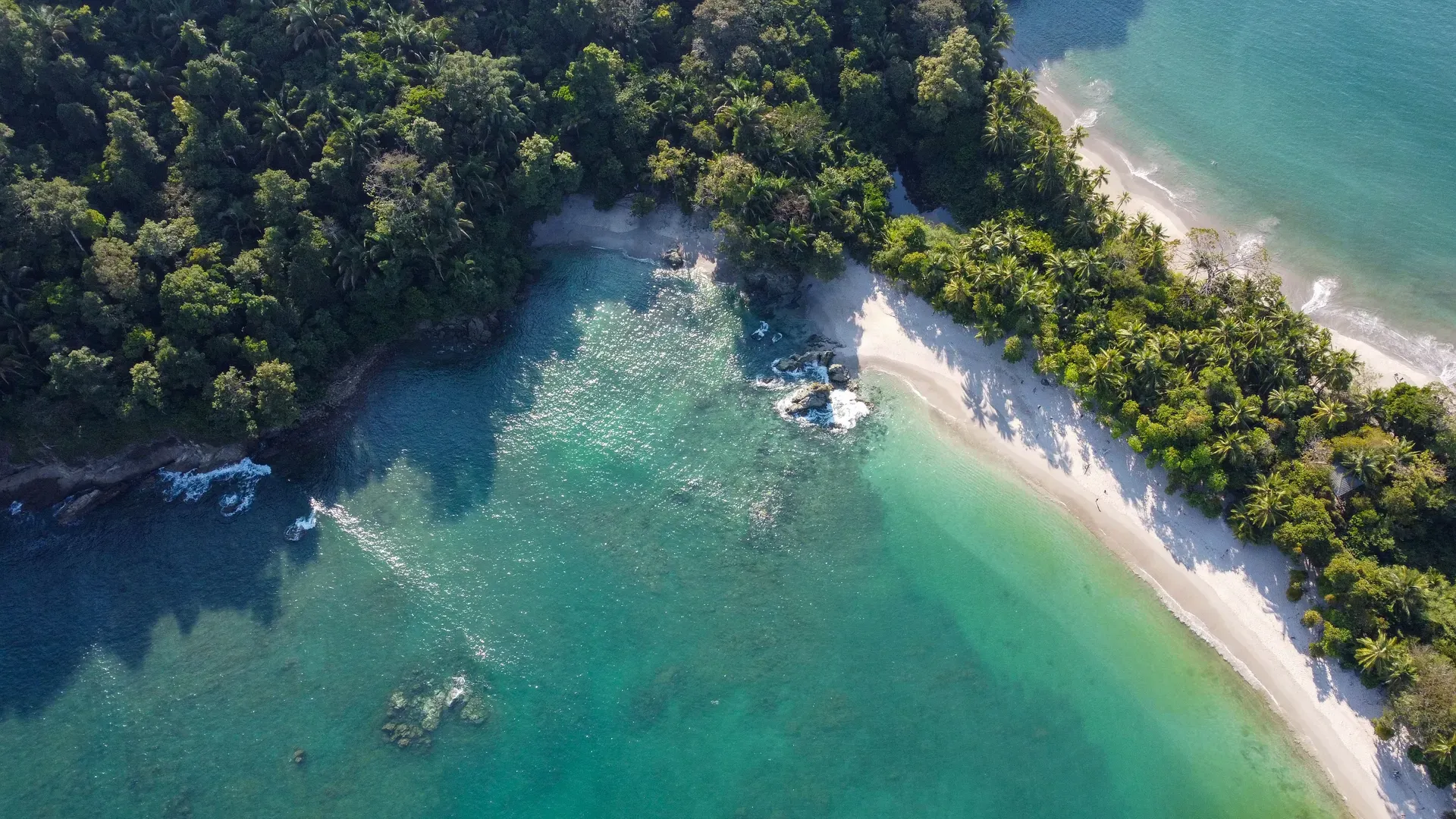
Manuel Antonio National Park squeezes rainforest, four white-sand beaches and an 18-hectare mangrove into 1,983 hectares on Costa Rica's central Pacific coast, 7 km south of Quepos. It's the country's smallest national park by land and its most visited — and the wildlife comes within arm's reach.
Manuel Antonio National Park packs a rainforest, four white-sand beaches, an 18-hectare mangrove and a scatter of rocky islands into 1,983 hectares on Costa Rica's central Pacific coast. It's the country's smallest park by land and its most visited, with 4,388,460 arrivals between 2012 and 2022. The town of Quepos sits 7 km to the northwest; San José is 157 km away. The smallest park drawing the biggest crowds is not a paradox — it's the whole point. You see animals here within meters of the trail that elsewhere in Costa Rica take days of hiking to find.
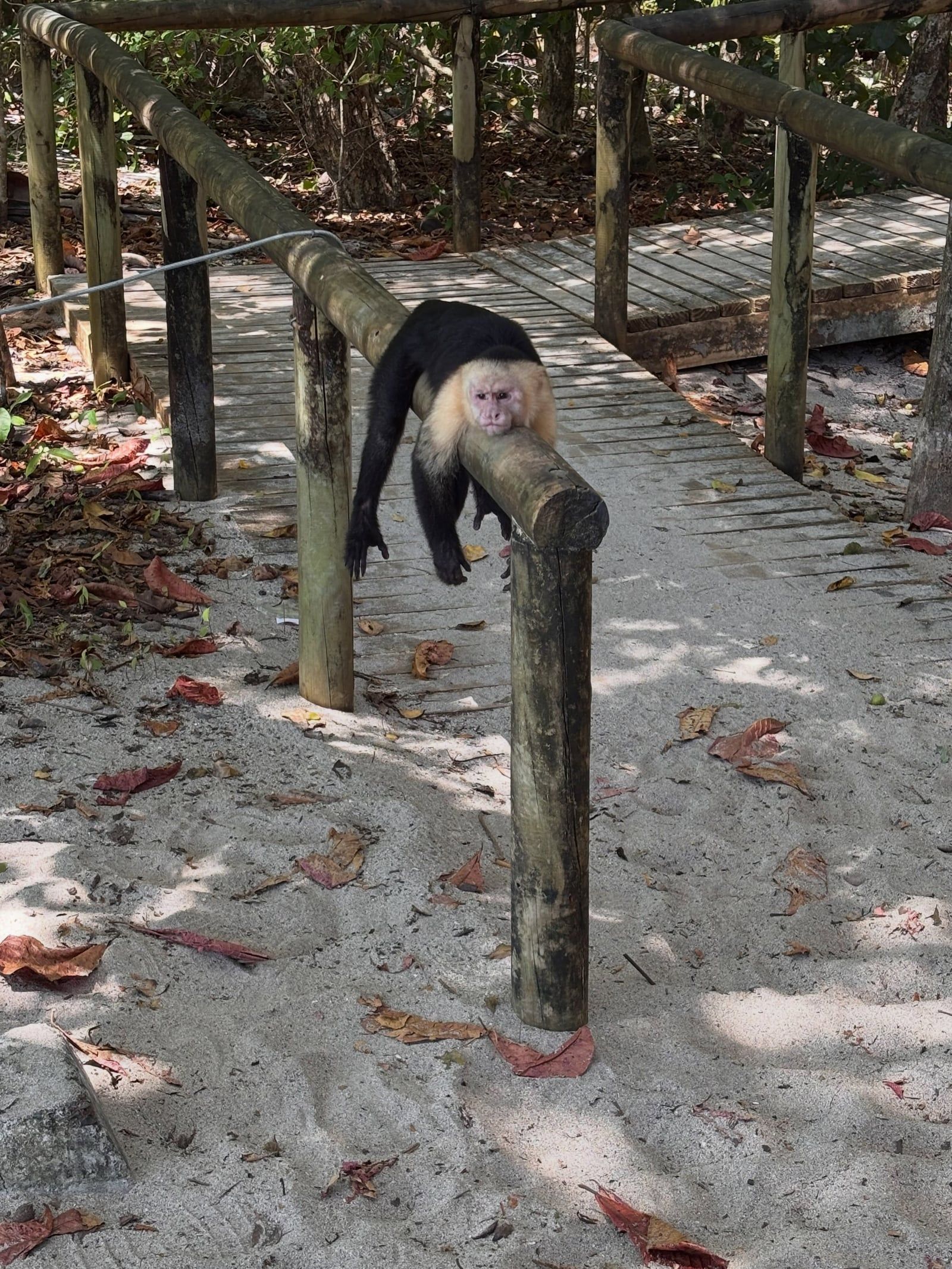
Two-toed and three-toed sloths hang in the cecropia trees along the flat, paved entrance trail. White-faced capuchins patrol the beach for unguarded bags (they can unzip a backpack in seconds), mantled howlers groan from the canopy at dawn, and the endangered Central American squirrel monkey — the mono tití, the park's emblem — lives here and in Corcovado and nowhere else in the country. The recorded species list runs to 352 birds, 109 mammals and 346 plants. For a park you can cross in a morning, that density is hard to beat anywhere in the Americas.
A typical visit lasts three to five hours: the trail circuit in the morning, then a swim at Playa Manuel Antonio, an 800-meter crescent of calm turquoise water backed by forest. The crowds are managed hard. Since a Constitutional Court ruling in May 2023, entry is capped at 1,120 visitors a day, tickets sell only through SINAC's online portal, and the park closes every Tuesday. Take the 7 a.m. slot and the trails are nearly empty; arrive at 10 a.m. in dry season and you'll walk in a procession of tour groups.
Manuel Antonio exists because residents of Quepos fought for their beaches. In the early 1970s, foreign landowners had restricted local access to the coast and were making plans to develop the area as a resort. Community pressure reached the Legislative Assembly, and in 1972 Costa Rica created the "Parque Recreativo Nacional Playas de Manuel Antonio" by Law No. 5100. The park was a local victory before it was a national one — its founding law amounts to a guarantee that these beaches stay public.
Administration passed to SINAC's Central Pacific Conservation Area (ACOPAC), with entry regulated by Decree No. 22482-MIRENEM, later modified by Executive Decree 42496-MINAE. In 2011, Forbes listed Manuel Antonio among the world's 12 most beautiful national parks, and the arrivals kept climbing. Over the decade from 2012, the park logged nearly 4.4 million visits, the highest count of any of Costa Rica's 30 national parks. At the peak, SINAC raised the daily allowance to 3,000 visitors — more than the trails and beaches could carry, as it turned out.
In May 2023 the Constitutional Court annulled SINAC's 3,000-visitor decision. The court found that the higher flow violated the constitutional right to a healthy environment and ordered the cap cut to 1,120 visitors per day, based on a 2022 visitor-flow study. The ruling made Manuel Antonio the national test case for how far tourism can grow inside a protected area: when the country's most popular park had to choose between revenue and the ecosystem, the ecosystem won.
Today the park runs Wednesday through Monday, 7 a.m. to 3 p.m., closing every Tuesday for trail maintenance — the single most common trip-planning mistake in the region. Tickets exist only online, sold in 15-minute arrival slots at serviciosenlinea.sinac.go.cr, with a maximum of six per transaction. Free entry days survive from the founding promise of public access: everyone gets in on August 24, National Parks Day, and Costa Rican residents enter free on the third Wednesday of each month.
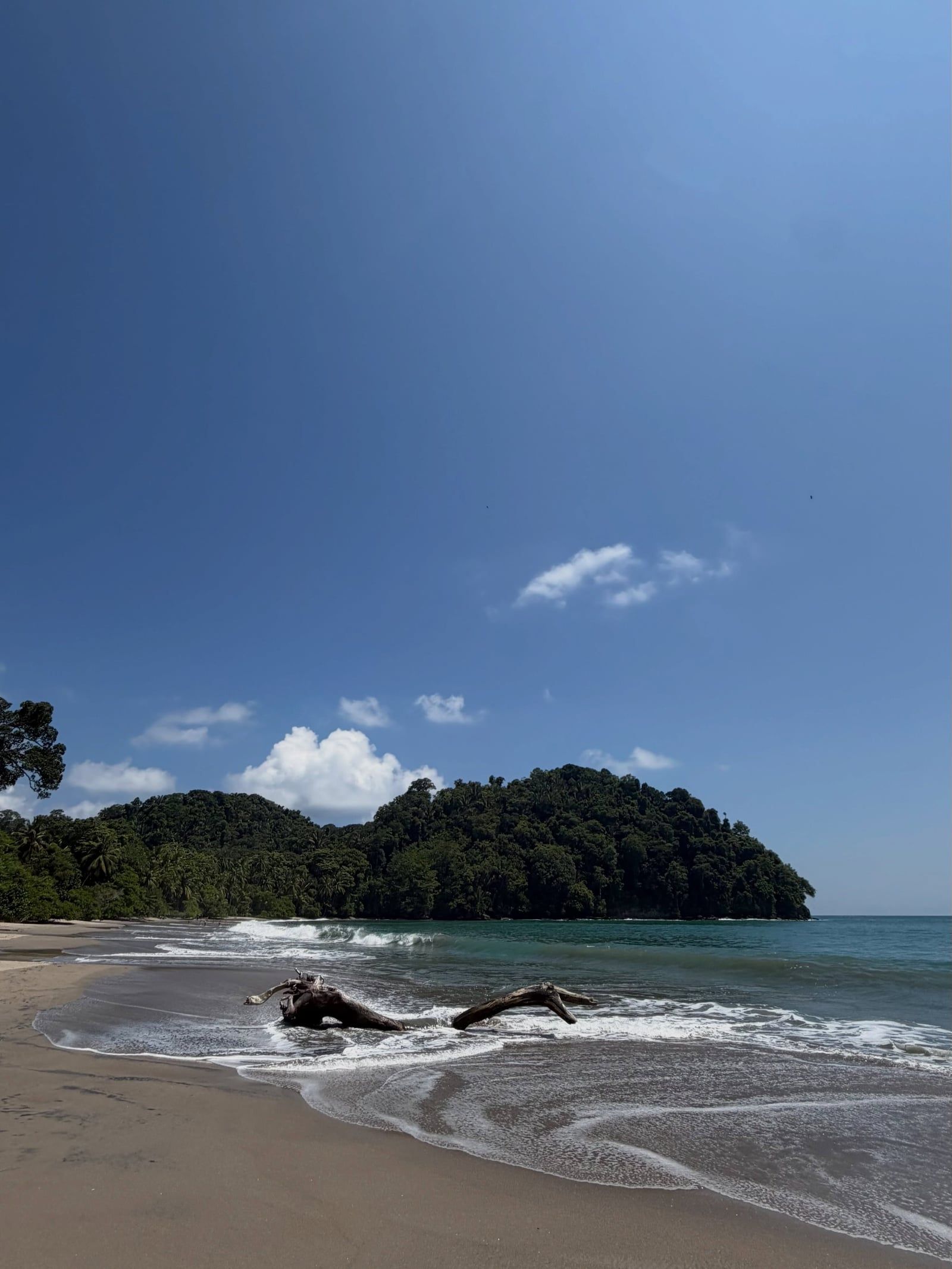
The terrain climbs from sea-level beaches through very humid tropical rainforest to overlooks at roughly 160 meters. Punta Catedral, the park's most distinctive landform, is a former island: a sand tombolo gradually attached it to the mainland, and its summit now rises 100 m over a 1.4 km loop trail. The coast itself sits on a tectonic fault, exposed as saw-toothed volcanic rock at Mirador Punta Serrucho — the name means "saw point," and the rock looks the part. Behind the beaches sit an 18-hectare mangrove of red, piñuela and caballero species and a 14-hectare lagoon. The marine protection dwarfs all of it: 25,634 hectares of ocean, thirteen times the land area.
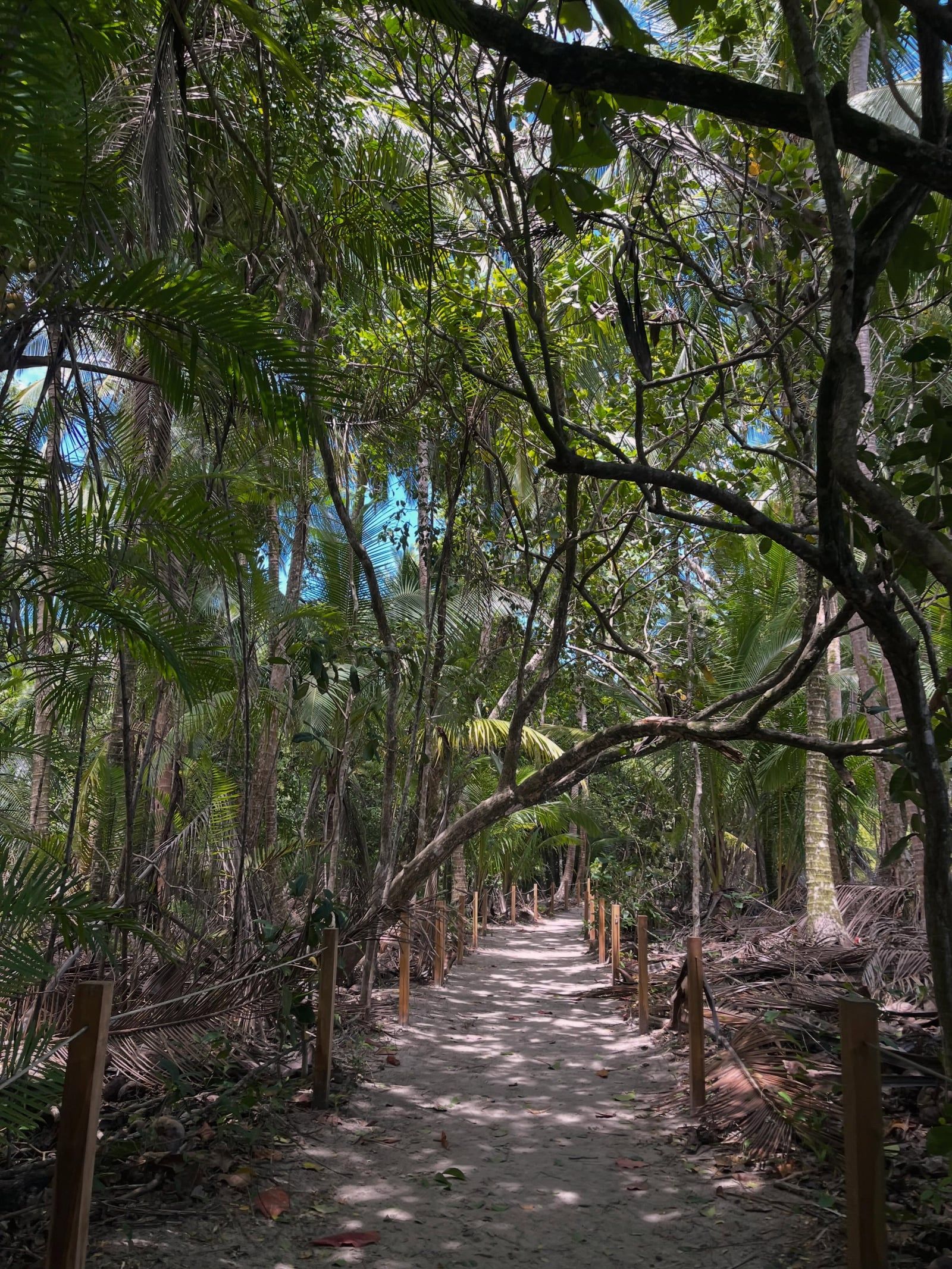
Sendero El Perezoso, the Sloth Trail, is the spine of a visit: 1.1 km one way, flat, paved, 20–30 minutes at a stroll, and passable by wheelchair and stroller. Sloths turn up most often in the cecropia trees along it — scan for a lump that doesn't match the branch. The Punta Catedral loop adds incline and five viewpoints over Pacific islands, some of them seabird rookeries. An elevated boardwalk crosses the mangrove in a 20–30 minute circuit, an entirely different ecosystem from the main forest, with water birds at first light. A small waterfall exists only in the rainy season; in the dry months its channel is just rock.
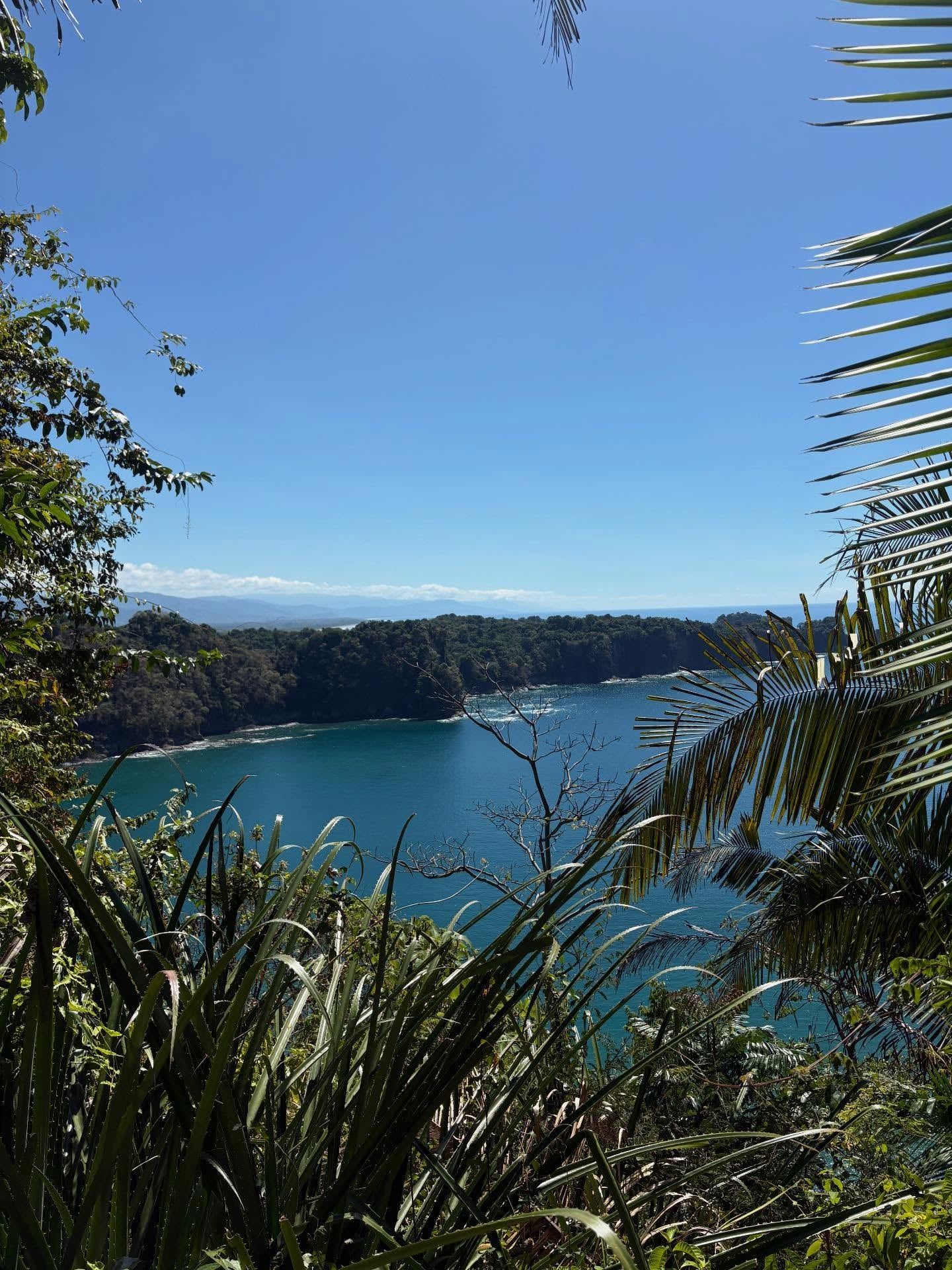
Four white-sand beaches line the shore. Playa Manuel Antonio, the famous one, is an 800-meter crescent with sheltered water — the park's swimming and snorkeling spot, with coral and marine life along its rocky sides. Playa Espadilla Sur is broader but carries stronger surf. Both beaches are fringed with manzanillo trees, whose sap and apple-like fruit blister skin; don't sit in their shade, and don't let kids pick up the fruit. Rain dripping from a manzanillo can burn too, so the shade rule holds even in a downpour.
Manuel Antonio belongs to Quepos in a way few parks belong to a town. Locals forced the park into existence in 1972, and the town's economy now runs on it — hotels, restaurants, boat charters, and a professional guiding class whose ICT-certified members, organized through the Association of Certified Tour Guides of Quepos, work the park entrance daily. For many families in the area, the park is both inheritance and payroll.
The human history on the land goes back much further. At low tide, from the Punta Catedral loop, you can see La Trampa: a circle of pre-Columbian stonework built by the Quepoa people to trap turtles and fish. It's one of the few places in Costa Rica where indigenous marine engineering sits inside a national park, visible to anyone who times the tide right.
For Costa Ricans, the park has become an argument as much as a destination. The 2023 Constitutional Court case was fought in the language of the constitution itself — the right to a healthy environment — and the ruling landed as a public statement that the country's most profitable park still answers to its ecosystems first. The mono tití, the endangered squirrel monkey on the park's emblem, is the face of that stance: a species whose Costa Rican range is reduced to this park and Corcovado. Free-entry days — August 24 for everyone, the third Wednesday of each month for residents — keep the founding promise of 1972 alive: these beaches belong to the public.
At 1,983 hectares, Manuel Antonio is one of Costa Rica's smallest national parks, yet it recorded 4,388,460 visits between 2012 and 2022 — more than any of the country's other 29 parks.
The headland anchoring the park's most popular hike was originally an offshore island. A sand tombolo slowly attached it to the mainland, and its old cliffs now rise 100 m above the loop trail.
The endangered Central American squirrel monkey, or mono tití, survives in Costa Rica only in this park and in Corcovado. It's the park's official emblem.
Every ticket must be bought in advance on SINAC's portal, serviciosenlinea.sinac.go.cr. People dressed as rangers sell fake tickets near the gate — genuine rangers wear SINAC logos and work only inside the park.
At low tide, the Punta Catedral loop overlooks La Trampa, a circle of ancient stonework built by the Quepoa people to trap turtles and fish — still visible in the water today.
The 1,983 hectares of forest and beach are just the visible fraction. The park also protects 25,634 hectares of ocean, bringing the total to 27,587 hectares.
The park's waterfall flows only in the rainy season. From December to April its channel runs dry, so don't plan a visit around it unless you're coming between May and November.
It was created by local protest. In the early 1970s, foreign landowners restricted Quepos residents' access to the beaches and planned resort development, and community pressure pushed the Legislative Assembly to establish the park by Law No. 5100 in 1972. The founding was, in effect, a legal guarantee that the beaches stay public.
No. There is no ticket booth at the gate — every ticket must be purchased in advance through SINAC's official portal, serviciosenlinea.sinac.go.cr, using passport details. People posing as rangers sell fake tickets near the entrance, so treat anyone selling tickets on the street as a scam. Bring the physical passport that matches your booking; a phone photo isn't accepted.
Every Tuesday, for trail maintenance. The park is open Wednesday through Monday, 7:00 a.m. to 3:00 p.m., year-round including holidays. Arriving on a Tuesday is the single most common trip-planning mistake visitors make.
Foreign adults (12+) pay $18.08 USD including tax, and children 2–12 pay $5.65; under-2s enter free. Costa Rican residents pay ₡1,808 for adults and ₡565 for children 6–12, with resident children under 6 and seniors in the Ciudadano de Oro program admitted free.
1,120, a limit ordered by Costa Rica's Constitutional Court in May 2023. The court annulled SINAC's previous decision to allow 3,000 daily visitors, ruling that the higher flow violated the constitutional right to a healthy environment, and set the new cap based on a 2022 visitor-flow study.
No, self-guided visits are allowed — but most visitors find a guide is the best money they spend. Sloths and camouflaged animals are nearly invisible unaided; certified guides with spotting scopes work at the entrance from 7:00 a.m. to 2:00 p.m. for roughly $40–70 per person. The Association of Certified Tour Guides of Quepos can be reached at 8671-1813.
Book 1–2 weeks ahead in dry season (December–April), and months ahead for Christmas–New Year and Easter week, when slots sell out. Entry is capped at 1,120 visitors a day in 15-minute arrival slots, and the park does not add capacity. The online-only portal closes sales when the day fills.
No food is allowed — bags are checked at the gate, and packaged snacks and single-use bottles are turned away. Drinks in reusable bottles are permitted, with refill fountains on the Sloth Trail and near the beaches. There's a concession cafeteria inside, open 7:30 a.m. to 3:30 p.m., and eating is allowed only in that designated area (capuchins will raid anything else).
Yes, in part. Sendero El Perezoso is flat and paved, and the beach boardwalks work for wheelchairs and strollers; the park has universal-accessibility facilities, rest areas and overlooks. The sand areas and the Punta Catedral loop, with its incline, are not accessible.
Humpback whale season runs August to November, when whales pass close to shore, and catamaran tours run throughout those months. Bottlenose dolphins are visible year-round. If whales are your priority, book a green-season trip — the crowds are thinner then too.
Browse verified tours with free cancellation and instant confirmation.
Find Tours